


AI Agents vs AI Tools: What’s the Difference?
Artificial intelligence has moved beyond simple chatbots and one-click generators. Today, there are thousands of AI-powered tools designed to perform individual tasks, while a newer generation of AI agents can handle multiple steps to accomplish a broader goal.
The difference can seem confusing at first. If an AI tool can write, analyse, generate images, summarise information, or transform data, what makes an AI agent different?
The simplest way to look at it is this: an AI tool usually helps you perform a task, while an AI agent can work through a series of tasks to achieve an objective.
Understanding that distinction can help you choose the right technology for everything from everyday productivity to content creation, research, business workflows, and repetitive digital tasks.
What Is an AI Tool?
An AI tool is software that uses artificial intelligence to perform a particular function.
For example, an AI-powered application might help you:
-
Generate or rewrite text
-
Summarise long documents
-
Create images
-
Improve photographs
-
Translate content
-
Analyse data
-
Convert or transform files
-
Generate ideas
-
Write or review code
-
Automate a specific repetitive task
Many AI tools are designed around a relatively straightforward input-and-output process. You provide something, select what you want the software to do, and receive a result.
This makes AI tools particularly useful when you already know what task you need to complete.
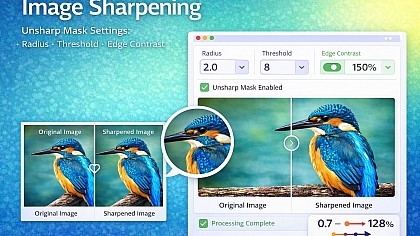
For example, if you need to sharpen an image, convert a file, or transform text into another format, a dedicated online tool can often do the job quickly without requiring a complicated workflow.
What Is an AI Agent?
An AI agent goes a step further.
Rather than simply responding to one instruction, an AI agent can be designed to plan, make decisions, use tools, and complete multiple steps toward a particular objective.
Imagine asking for help with a research task.
A conventional AI tool might answer your question based on the information available to it. An AI agent, depending on how it is designed and what permissions it has, could potentially break the request into smaller tasks, gather information, process the results, and produce an organised final output.
The important concept is not simply that an AI agent is "smarter". It is that the agent can operate as part of a multi-step workflow.
AI Tools vs AI Agents
The distinction becomes clearer when the two are compared.
| AI Tools | AI Agents |
|---|---|
| Usually focused on a specific task | Designed around a broader objective |
| Often require a new instruction for each task | Can potentially manage multiple steps |
| Input → processing → output | Goal → planning → actions → result |
| Usually straightforward to use | May involve more complex workflows |
| Ideal for quick, individual tasks | Useful for multi-step processes |
| Often highly specialised | Can combine different capabilities |
This does not mean AI agents will replace ordinary AI tools.
In fact, specialised AI tools can be extremely useful inside larger AI workflows. An agent may need different tools to analyse information, manipulate files, generate content, or complete other actions.

When Should You Use an AI Tool?
A dedicated AI tool is often the better choice when the task is simple and clearly defined.
For example, you probably don't need an AI agent if you simply want to:
-
Resize an image
-
Sharpen a photograph
-
Convert a file
-
Count words
-
Transform text
-
Generate a quick piece of content
-
Create a simple image
-
Check or manipulate structured data
For these jobs, a focused online tool can be faster than setting up a complicated automated workflow.
This is one reason collections of practical online tools remain useful even as AI becomes more sophisticated. The best solution is often the one that gets a specific job done with the least friction.
When Does an AI Agent Make More Sense?
AI agents become more interesting when a task involves several connected actions.
For example, imagine a workflow that requires you to research a topic, organise information, compare multiple sources, prepare a summary, and then turn the findings into a structured document.
Doing each stage manually could take considerable time.
An appropriately configured AI agent could potentially coordinate several of those steps, depending on the agent's capabilities and the tools or services it can access.
Other potential use cases include:
Research
An agent can potentially break a research objective into smaller tasks and organise the resulting information.
Content Workflows
Instead of simply generating a paragraph, an AI-powered workflow could potentially help with research, outlining, drafting, editing, and formatting.
Business Administration
Repetitive digital processes involving multiple applications can be good candidates for agent-based automation.
Data Processing
An agent may be able to combine different operations rather than requiring a user to manually move information from one step to another.
Productivity
Personal and professional workflows that involve repeated sequences of actions may benefit from automation.
The exact capabilities vary considerably between AI agents, so it is important to check what an individual agent can actually access and do rather than assuming every AI agent works autonomously.
Where Can You Find AI Agents?
As the AI ecosystem grows, finding an appropriate agent for a particular task can be just as challenging as finding a conventional software tool.
There are now directories and specialised marketplaces designed to help users find AI agents for different purposes. For example, the AI Agent Store provides a dedicated place to browse AI agents and find solutions for different use cases.
This type of marketplace can be useful when you know the outcome you want but don't necessarily want to build an agent or automation workflow from scratch.
AI Agents Don't Make Traditional Tools Obsolete
It is tempting to think that AI agents will eventually replace every other type of software.
That is unlikely.
A specialised tool can have significant advantages when you need to complete one task quickly. A dedicated image-processing tool, for example, does not need to understand an entire business workflow before it can sharpen an image.
The same applies to utilities for text, files, calculations, data conversion and other everyday digital tasks.
In many cases, the future is more likely to involve AI agents working alongside specialised tools rather than agents replacing them completely.
An agent might coordinate a workflow while individual tools perform the specific operations required along the way.
How Toolonic Fits Into the AI Tools Landscape
Toolonic focuses on practical online tools that help users complete specific digital tasks without unnecessary complexity.
That approach remains valuable in an AI-driven environment.
Not every task needs an autonomous agent. Sometimes you simply need a quick utility that performs one job and lets you move on.
For example, a user working on an AI-generated image may still need to sharpen it, convert it, resize it, or transform it before using the final result. Someone working with AI-generated text may still need to count words, change formatting, or convert structured information into another format.
These smaller operations are where straightforward online tools can save time.
The growing AI ecosystem therefore creates opportunities at both ends of the spectrum: specialised tools for individual tasks and AI agents for more complex workflows.
What Should You Look For in an AI Agent?
If you're considering using an AI agent, don't choose one simply because it describes itself as "autonomous" or "intelligent".
Look at what it actually does.
Consider:
1. The task it is designed to perform: A narrowly focused agent may be more useful than a general-purpose system if your objective is specific.
2. Available integrations: An agent's usefulness can depend heavily on which applications, websites, APIs, or other tools it can work with.
3. Level of automation: Find out which actions the agent can perform automatically and which steps still require your approval.
4. Privacy and security: If an agent can access documents, accounts, or other sensitive information, understand what data it needs and how that information is handled.
5. Human oversight: For important work, having the ability to review or approve actions can be more valuable than complete autonomy.
6. Reliability: An impressive demonstration does not necessarily mean an agent will perform consistently in real-world situations. Test it with representative tasks before relying on it for important workflows.
The Future Is Likely to Be a Combination of Both
AI tools and AI agents should not necessarily be viewed as competing technologies.
They solve different problems.
If you have one clearly defined task, a specialised AI or online tool may be the fastest solution. If you have a complicated objective involving research, decisions, and several connected actions, an AI agent may offer a more efficient approach.
The interesting part is what happens when the two are combined.
AI agents can potentially coordinate multiple specialised tools, while individual tools continue to provide the focused functionality needed to complete specific operations.
For users, that means the most useful question is no longer simply "Which AI is best?"
Instead, ask:
"What am I trying to accomplish, and do I need a tool, an agent, or a combination of both?"
That small change in perspective can make the rapidly expanding world of AI software much easier to navigate.
Categories
Recent Posts

0.2548